
Bioceramic sealers, primarily calcium silicate-based materials, represent a significant technological advancement in the endodontic space, shifting the focus of treatment from simply filling a void to actively promoting tissue regeneration and healing. While epoxy resin-based sealers have long been considered the “gold standard” due to their excellent sealing ability and dimensional stability, they possess inherent limitations such as cytotoxicity, hydrophobicity, and a lack of bioactive potential.
Bioceramic materials address these challenges through several defining characteristics:
Unlike inert traditional sealers, bioceramics are bioactive, meaning they interact with living tissue to induce specific cellular responses. They release calcium and silicate ions, which promote the migration and viability of human dental pulp stem cells (hDPSCs) and support their differentiation into osteoblasts (bone-forming cells). This makes them “osteoinductive platforms” capable of supporting the repair of periapical bone and the remineralization of lesions.
In the endodontic space, bioceramics are categorized into two main forms:
Bioceramic sealers exhibit superior biocompatibility compared to traditional resin sealers. Research indicates that they are non-toxic to periapical tissues and can lead to faster clinical healing with fewer post-treatment complications. Even in cases of unintentional extrusion into the periapical region, their high biocompatibility minimizes inflammatory responses and supports the regenerative process.
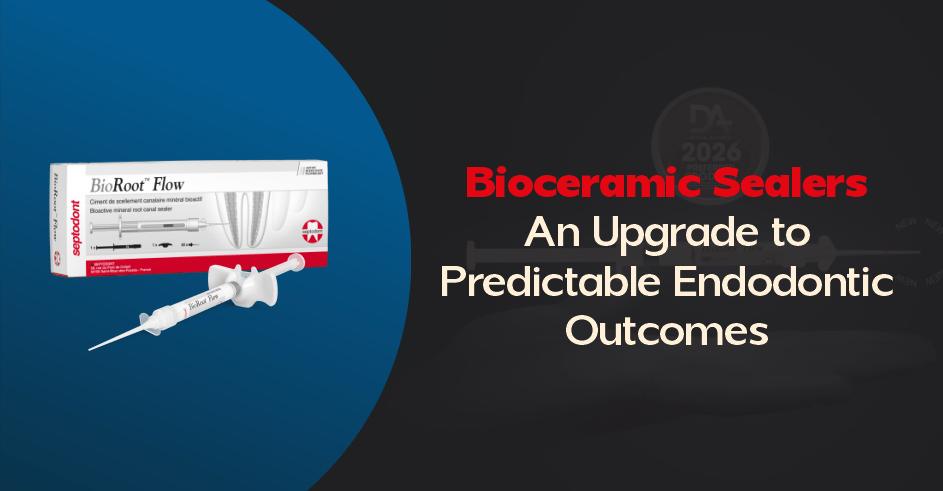
BioRoot Flow (BRF) is a novel premixed bioceramic sealer indicated for endodontic treatments with no shrinkage and limited bacteria growth.
Whether using cold or warm obturation techniques, or more modern approaches such as hydraulic condensation or single
cone obturation, BioRoot Flow is designed to make permanent root canal fillings fast, simple, and successful.
The sealer’s pure, resin-free, calcium silicate mineral formulation flows easily into canals and provides strong adhesion to both dentin and gutta percha. Its biocompatibility reduces the risk of adverse reactions, while its bioactive properties induce hydroxyapatite crystal formation to aid in tooth remineralization.
Ref:
Clinical applications and perceptions of bioceramics in endodontics: a cross-sectional survey – MJS Publishing.
Biocompatibility and Bioactivity Evaluation of Novel Calcium Silicate-Based Sealer.
Osteoinductive and regenerative potential of premixed calcium- silicate bioceramic sealers on vascular wall mesenchymal stem cells – Unibo.
Physicochemical Properties and Biocompatibility of Various Bioceramic Root Canal Sealers: In Vitro Study.
Sign up now and get an exclusive access to: