Endodontics
For decades, the “gold standard” in root canal treatment has been about achieving a tight, hermetic seal. While epoxy-resin sealers have long been favored for…
1 minute read
Successful root canal treatment relies on effective biomechanical preparation, thorough disinfection, and fluid-tight three-dimensional obturation to eliminate microorganisms, prevent reinfection, and promote periapical healing.
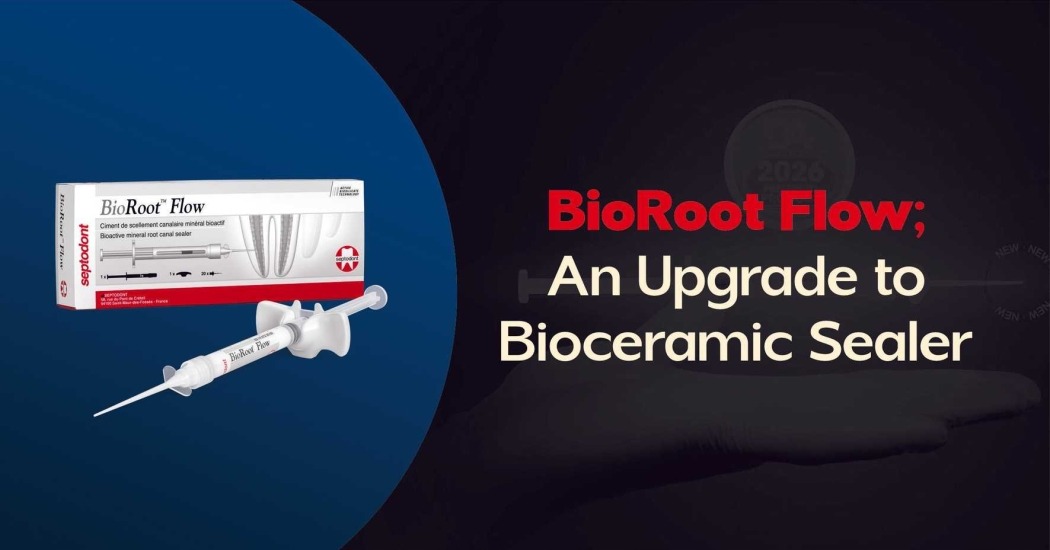
BioRoot Flow is primarily a calcium silicate-based bioceramic material that exhibits bioactivity, biocompatibility, antibacterial properties, and moisture-activated settings. It chemically bonds to dentin via hydroxyapatite formation, creating a “mineral infiltration zone,” which enhances interfacial sealing and tissue response.
As a premixed injectable bioceramic sealer, BioRoot Flow represents a significant advancement by providing consistent viscosity, syringe-based delivery, reduced procedural errors, and improved handling in complex anatomies compared to powder-liquid or two-paste systems.
According to a study comparing key evaluation parameters including dentinal tubule penetration (which increases interfacial area and blocks microbial pathways), void formation (which compromises seal integrity and permits leakage), and push-out bond strength (which reflects resistance to dislodgement under functional loads) of three premixed injectable bioceramic sealers, including BioRoot Flow, with those of a conventional epoxy resin-based sealer.1
BioRoot Flow provided superior dentinal tubule penetration and significantly reduced void formation compared to epoxy sealer, with clinically acceptable bond strength. It stands out for its superior characteristics such as hydrophilicity, fine particle size, and flowability, which promote deeper dentinal tubule penetration and superior adaptation.1
BioRoot Flow demonstrated the highest penetration depth at all levels (coronal: 1199.43 ± 104.75 µm; middle: 990.95 ± 116.69 µm; apical: 709.65 ± 121.99 µm).1
Tight seal
Alkaline environment
Bioceramic Bioactive Biocompatible
Handling & delivery
Compatible with all obturation techniques
1. DOI: 10.7759/cureus.102804
Sign up now and get an exclusive access to: