All about Biodentine

BiodentineTM is both a restorative material and a pulp therapeutic in one. Made from ultra-pure tricalcium silicate using patented Advanced Biosilicate (ABS) TechnologyTM,  BiodentineTM is free from the heavy metals and other impurities found in calcium silicate cements like MTA.1,2,3 4

This means that BiodentineTM has no mutagenic, sensitising, irritant or inflammatory effects on the pulp, even when the dentine barrier is thin.5,6,7 To the contrary, it actively works with the innate healing capabilities of the pulp, stimulating angiogenesis and growth factor release to enhance biologic healing.5,6

Biodentine has a wide range of applications including pulp capping, endodontic repair such as root perforations, apexification, resorptive lesions, and retrograde filling material in endodontic surgery, and can be used as a dentine replacement material in restorative dentistry.

Biodentine can be used both in the crown and in the root. In the crown region it is used as a base, provisional seal, for deep caries therapy, as a cervical filling, for direct and indirect pulp capping and in pulpotomies.

In the region of the root, Biodentine can be used for the treatment of perforations of the root canal or pulp chamber floor, internal and external absorption processes, for apexification and as a retrograde root canal filling material.

On one hand, Biodentine serves as a dentine replacement, and on the other hand it is used for maintaining the vitality of the dental pulp or stimulation of hard tissue regeneration, i.e. both tertiary dentine formation and also bone regeneration, e.g. after root end surgery.
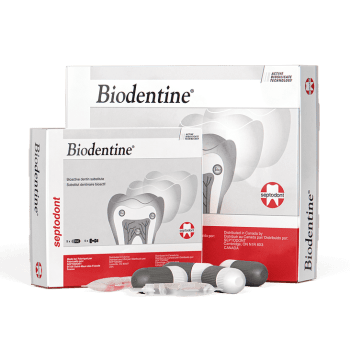
PROPERTIES

  • Biodentine® is a bioactive dentin substitute from the “Active Biosilicate Technology ” innovation.
  • Biodentine has mechanical properties similar to the sound dentin and can replace it both in the crown and in the root, without any preliminary conditioning of mineral tissues
  • Biodentine contains high-purity, monomer-free mineral ingredients and is highly biocompatible.
  • Biodentine creates the optimal conditions for maintenance of pulp vitality, by providing a very tight seal on the dentin surface. It therefore reduces the risk of postoperative sensitivity and the longevity of restorations in vital teeth.
  • Biodentine, being bioactive, stimulates the pulp cells to build reactionary dentin. The dentin bridges are created faster and thicker than with similar dental materials and represent the necessary condition for optimal pulp healing.
  • Biodentine offers an initial setting time reduced down to 12 minutes from start of mix, for optimal use in the crown.

INDICATIONS

In the crown:

  • Permanent dentin restoration under composites or Inlay/Onlay
  • Temporary dentin-enamel restoration.
  • Restoration of deep and/or large coronal carious lesions (sandwich technique).
  • Restoration of cervical radicular lesions.
  • Pulp capping.
  • Pulpotomy.

In the root:

  • Repair of root perforations.
  • Repair of furcation perforations.
  • Repair of perforating internal resorptions.
  • Repair of external resorption
  • Apexification.
  • Root-end filling in endodontic surgery (retrograde filling).
  1. Watson, T.F., Atmeh, A.R., Sajini, S. et al. (2014) ‘Present and future of glass-ionomers and calcium-silicate cements as bioactive materials in dentistry: biophotonics-based interfacial analyses in health and disease’, Dental Materials, 30(1), pp. 50–61. Available at: https://pmc.ncbi.nlm.nih.gov/articles/PMC3885799/
  2. Camilleri, J. (2011) ‘Characterization and hydration kinetics of tricalcium silicate cement for use as a dental biomaterial’, Dental Materials, 27(8), pp. 836–844. Available at: https://www.sciencedirect.com/science/article/abs/pii/S0109564111001151
  3. Septodont (n.d.) BioRoot™ Endo Sealer or Biological Filler. Available at: https://info.septodontcorp.com/freemium-bioroot-endo-sealer-or-biological-filler
  4. Camilleri, J. (n.d.) Biodentine™: The dentine in a capsule or more. Septodont Learning. Available at: https://www.septodontlearning.co.uk/sites/default/files/Biodentine-The-dentine-in-a-capsule-or-more-by-Josette-Camilleri-compressed.pdf
  5. Internal data: Biodentine™ XP Scientific file (2022).
  6. Hashem, D., Mannocci, F., Patel, S. et al. (2015) ‘Clinical and radiographic assessment of the efficacy of calcium silicate indirect pulp capping: a randomized controlled clinical trial’, Journal of Dental Research, 94(4), pp 562-568. Available at: https://pmc.ncbi.nlm.nih.gov/articles/PMC4485218/
  7. Nowicka, A., Lipski, M., Parafiniuk, M. et al. (2013) ‘Response of human dental pulp capped with Biodentine and mineral trioxide aggregate’, Journal of Endodontics, 39(6), pp. 743–747. Available at: https://www.jendodon.com/article/S0099-2399(13)00133-7/abstract
Register for free
1/4 Choose your login information

Your password must contain at least:

8 characters

A number and a letter

A special character

2/4 Enter your personal information
4/4 Confirm

Register for free

Sign up now and get an exclusive access to:

  • Live webinars and webinar replays to learn from the best speakers in dentistry.
  • Educational content in a variety of formats (articles, podcasts, clinical cases, videos, and more) to enhance your skills and achieve business success.
  • Our Voice of Customer program to contribute in creating innovative products that address your needs.
Create an account
Sign up now Already a member? Log-in!
Forgot your password?

Enter your email address below.

We will send you a password reset link by email.

Cancel
Subscribe to our Newsletter