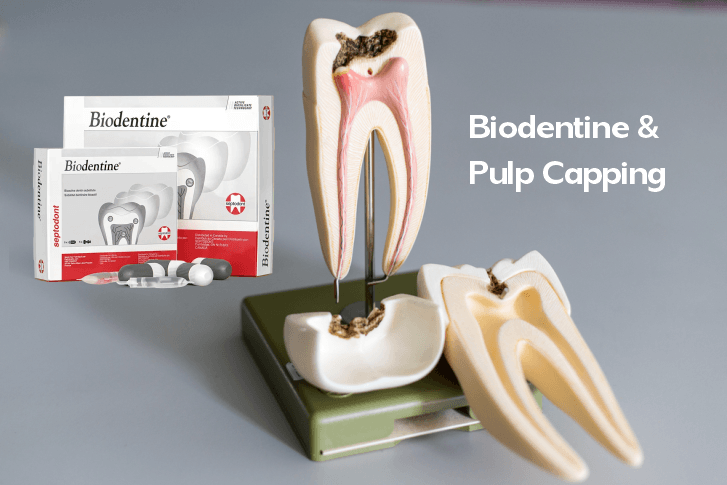
Pulp capping is the preservation of tooth vitality by forming a barrier between the pulp and the surrounding environment. A successful formation of this barrier avoids the need for further treatment and helps in the conservation of the pulp-dentin complex.1
The dentine-pulp complex is a unique mineralised connective tissue that is composed of two integrated constituents: the pulp – an underlying gelatinous soft connective tissue which has a rich vasculature and is well innervated, and dentine – an outer casing of mineralised tissue.2
The pulp is under threat from three main sources: carious attack, trauma and iatrogenic damage (Bjørndal et al 2019). Prior to providing any definitive restoration for a tooth it is important to determine if there is any disease associated with the pulp based on the patient’s symptoms and clinical examination.2
Management of exposed pulp can be accomplished by pulp capping procedure. Pulp capping prevents the pulp from external stimuli by forming a seal between the oral environment and the pulp, which in turn prevents the progression of microorganisms.1
Types of pulp capping
Indirect pulp capping2:
Application of a biomaterial onto a thin dentine barrier in a one-stage complete carious tissue removal technique generally to hard dentine
- Asymptomatic carious lesion without pulp exposure where selective caries removal is not indicated
- Reversible pulpitis without pulp exposure
Direct pulp capping2:
Application of a biomaterial directly onto the exposed pulp, before immediate placement of a permanent restoration
- Asymptomatic carious lesion with pulp exposure
- Reversible pulpitis with pulp exposure
Direct versus indirect pulp capping2:
Determining the most favorable treatment strategy for managing pulpitis is multifactorial. Pre-operative clinical and radiographic investigations play a key role, as the diagnosis affects the level of VPT performed. However, intra-operative findings also influence decision-making.
Which material should you use?3
Ideal Properties of Pulp Capping Materials:
- Stimulate reparative Dentin formation,
- Maintain Pulp Vitality,
- Release Flouride to prevent secondary caries
- Bactericidal or bacteriostatic
- Adhere to dentin
- Adhere to restorative material
- Resist force during restoration placement and during the life of restoration.
- Sterile
- Radioopaque
- Provide bacterial seal
Why is Biodentine a promising material for pulp capping?
BiodentineTM is both a restorative material and a pulp therapeutic in one. Made from ultra pure tricalcium silicate using patented Advanced Biosilicate (ABS) TechnologyTM, BiodentineTM is free from the heavy metals and other impurities found in calcium silicate cements like MTA.4,5,6
Dentine remineralization:
As bioactive material, BiodentineTM promotes dentine remineralisation through the formation of reactionary dentine and dentinal bridges.7,8,9,10,11 The high alkalinity degrades collagen at the dentine interface, creating a very porous surface and a distinct “mineral infiltration zone.”10,14
Thanks to its very high alkaline pH, BiodentineTM creates an unhospitable environment for residual bacteria once placed.10,12,13 When compared to MTA and GIC in in vitro studies, BiodentineTM demonstrates a higher potential to limit bacteria proliferation thanks to its alkaline pH.10
BiodentineTM bonds tightly to the dentine wall via micro-mechanical anchorage, depositing mineral tags into the dentinal tubules.10,14
BiodentineTM’s compressive strength continues to improve after application and gradually reaches the strength of natural dentine within 28 days 13.
With Biodentine™, you can rely on a clinically proven material for indirect or direct pulp capping, supported by extensive scientific and clinical evidence.
- Current key to clinical success in pulp capping: A review https://ijce.in/archive/volume/8/issue/3/article/3733/pdf
- Vital pulp therapies in permanent teeth: what, when, where, who, why and how? https://doi.org/10.1038/s41415-025-8560-3
- Biodentine: an effective pulp capping material DOI: 10.36347/sjds.2016.v03i01.005
- Watson, T.F., Atmeh, A.R., Sajini, S. et al. (2014) ‘Present and future of glass ionomers and calcium-silicate cements as bioactive materials in dentistry: biophotonics-based interfacial analyses in health and disease’, Dental Materials, 30(1), pp. 50–61. Available at: https://pmc.ncbi.nlm.nih.gov/articles/PMC3885799/
- Camilleri, J. (2011) ‘Characterization and hydration kinetics of tricalcium silicate cement for use as a dental biomaterial’, Dental Materials, 27(8), pp. 836–844. Available at: https://www.sciencedirect.com/science/article/abs/pii/S0109564111001151
- Camilleri, J. (n.d.) Biodentine™: The dentine in a capsule or more. Septodont Learning. Available at: https://www.septodontlearning.co.uk/sites/default/files/Biodentine-The-dentine in-a-capsule-or-more-by-Josette-Camilleri-compressed.pdf
- Internal data: Biodentine™ Scientific file (2011). Pages 20-23. Pages 24-28.
- Hashem, D., Mannocci, F., Patel, S. et al. (2015) ‘Clinical and radiographic assessment of the efficacy of calcium silicate indirect pulp capping: a randomized controlled clinical trial’, Journal of Dental Research, 94(4), pp 562-568. Available at: https://pmc.ncbi.nlm.nih.gov/articles/PMC4485218/
- Nowicka, A., Lipski, M., Parafiniuk, M. et al. (2013) ‘Response of human dental pulp capped with Biodentine and mineral trioxide aggregate’, Journal of Endodontics, 39(6), pp. 743–747. Available at: https://www.jendodon.com/article/S0099 2399(13)00133-7/abstract
- Kaur, M., Singh, H., Dhillon, J.S. et al. (2017) ‘MTA versus Biodentine™: Review of literature with a comparative analysis’, Journal of Clinical and Diagnostic Research, 11(8), pp. ZG01–ZG05. Available at: https://pmc.ncbi.nlm.nih.gov/articles/PMC5620936/
- Sajini, S., Atmeh, A., Banerjee, A. et al. (2022) ‘Glass-ionomer and calcium silicate based cements interactions with human dentine in health and disease: Two-photon fluorescence microscopy and Raman spectroscopy analysis’, Dental Materials, 38(11), pp. 1710–1720. Available at: https://www.sciencedirect.com/science/article/abs/pii/S0109564122002536?via%3Dihub
- About, I. (2022) Biodentine: Properties and Clinical Applications. Switzerland: Springer. URL: https://link.springer.com/book/10.1007/978-3-030-80932-4
- Lundy, F.T., Giraud, T., El-Karim, I.A. et al. (2022) ‘Biodentine™ in inflammation and pain control’, in About, I. (ed.) Biodentine: Properties and Clinical Applications. Switzerland: Springer, pp. 51–66. URL: https://link.springer.com/book/10.1007/978 3-030-80932-4
- Atmeh, A.R., Chong, E.Z., Richard, G. et al. (2012) ‘Dentin-cement interfacial interaction: calcium silicates and polyalkenoates’, Journal of Dentistry, 91(5), pp. 454–459. Available at: https://pmc.ncbi.nlm.nih.gov/articles/PMC4077527/